Think back to the intense protests regarding fuel prices that brought everything to a standstill barely a fortnight ago.
All public transport was completely suspended, roads were blocked, and commuting was fundamentally impossible. It wasn’t a matter of employees being lazy; they were automatically and completely forced to stay at home for safety.
Yet, how did some HR departments handle it? There were still managers and HR professionals who tried to enforce rigid, old-school 9-to-5 desk policing, desperately sending out emails demanding people show up simply because “that’s what the manual says.”
By ignoring reality, they completely lost the trust of their teams. Meanwhile, organizations that had stubbornly resisted modern workplace flexibility were hit with a massive shock, work was completely suspended for two whole days because they didn’t have a backup plan. This single crisis forced those lagging companies to frantically start drafting and enforcing remote work policies.
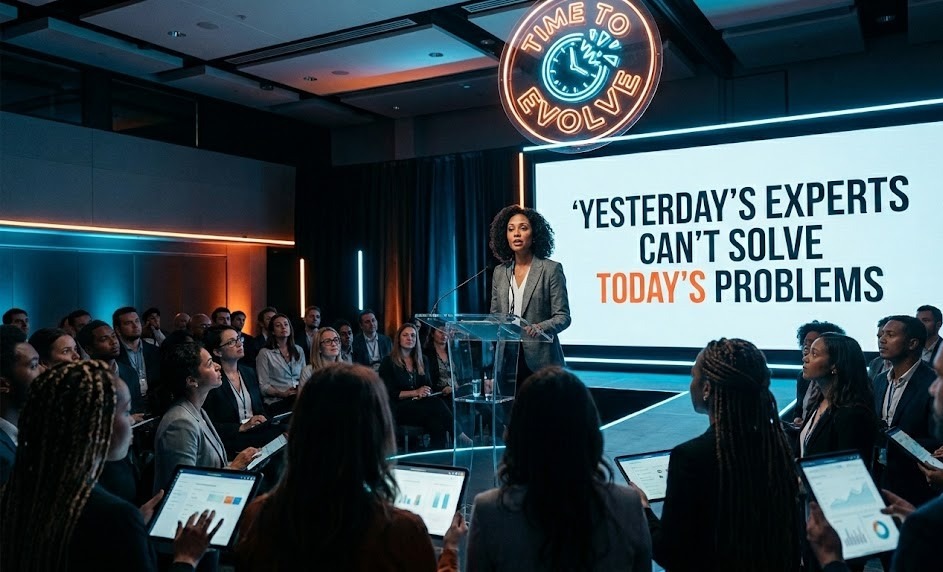
It exposes a hard, uncomfortable truth that every single one of us in the profession needs to face: Yesterday’s experts cannot be today’s experts.
If you are relying entirely on the credentials, theories, and rigid habits you picked up years ago to manage people today, you aren’t just falling behind, you are becoming a liability to your organization.
The Danger of the “15-Year” Illusion
We see it on CVs and LinkedIn all the time: “15 years of HR experience.”
But here is the real question we need to ask ourselves: Is that actually 15 years of deep, evolving, strategic experience? Or is it just one single year of experience repeated 15 times?
Having a long career in Human Resources is admirable, but longevity does not automatically equal relevance anymore. The recent fuel crisis, Covid- 19 pandemic proved that the workplace changes overnight. If your approach to crisis management, talent oversight, and employee engagement is exactly the same as it was a decade ago, you are managing a workforce that no longer fits into your rigid boxes.
Before we can step into a boardroom and tell business owners how to transform their companies, we have to look in the mirror first. We have to be willing to practice what we preach and self-disrupt. This means questioning our own biases, tearing up outdated policies that don’t make sense during a crisis, and admitting when our old ways of working are completely broken.
The 5-Year Shelf-Life: Why Education Cannot Be Static
This isn’t just a challenge for the individual professional; it is a massive wake-up call for training institutions and educators as well.
Knowledge has a shelf-life. The reality is that a static, rigid HR curriculum written five years ago is already losing its grip on the current market. If students are being taught theories out of old textbooks without understanding how to manage sudden disruptions like a two-day national transport freeze, we are failing them.
Should the curriculum be constantly revised? Absolutely. It is the only way to ensure that graduates stay at the absolute top of their game.
An educational institution cannot just be a factory that hands out paper certificates. It must be a dynamic, living ecosystem that actively listens to the market. If real-world dynamics change on a random Tuesday, the classroom discussion must change on Wednesday. If emerging technologies or sudden crises alter how work is delivered, the curriculum must adapt immediately to give students real-world, practical toolkits.
Learning to Unlearn
The true mark of a modern HR professional isn’t how much they know, it’s how fast they can unlearn what is no longer useful.
Being a top-tier practitioner today means leaning into the discomfort of continuous learning. It means sitting in classrooms, taking professional certifications, and actively debating real-world case studies with peers so that the next time a crisis hits, you aren’t caught off guard. It’s about moving away from being the “policy police” and becoming an agile partner in business survival.
The Final Verdict:
The future of work is moving fast, and it isn’t waiting for anyone to catch up. The recent protests showed us again that agility isn’t a luxury, it’s a survival metric. If HR misses the opportunity to self-disrupt, the market will do it for them, and the cost will be incredibly high.
Look inside, audit your current skills, and don’t be afraid to update your thinking. Because the moment we stop learning as HR professionals is the exact moment, we stop being useful to the people we are meant to lead.